Thursday, 22 March 2012

Reflection No.3 --- The Stereo Corner


In one of the corners of the main room, we have a reading area. Besides the shelves of normal story books, there’s a stereo corner with a shelf full of story books with digital resource. This stereo corner has its own set of table, chairs and a stereo. The books in this corner all have either tape or CD with them. Children are free to turn the stereo on and read the books along the recorded stories. The corner contains classic stories, new stories, and popular stories around the children.

The children love this digital-reading corner and have their own favourite stories here. Most children can use the stereo quite well. They even teach their friends to use the stereo and have fun reading the stories together!  This shows that most of the children already have the skills to control the stereo. They are also competent enough to help each other solving problems in using technology. Therefore, the children are gaining their growing understanding of how technologies can help them and others (Ministry of Education, 1996), in this case, by using the stereo to help a child himself and his friend to read the stories. The children literally run the corner themselves. Sometimes they would grab my hand and ask me to join. Learning to use the stereo helps children to develop working theories for making sense of the modern technological world (Ministry of Education, 1996). Being capable of using the stereo gives them the strategies and confidence for actively exploring and making sense of the world by using technological equipments (Ministry of Education, 1996). Constantly having the stereo available for children provides them rich opportunities to experience some of the technology and resources for reading (Ministry of Education, 1996).

What captures the children’s interest in the stereo corner? Besides the popularity of the stories, I think there are two key advantages included: children taking control and developing self-help skills. First of all, children may have a sense of achievement controlling the stereo. In early childhood settings, stereos are normally used for mat time by teachers. At mat time, there are rules and boundaries that teachers are mostly in control of choosing the stories and using the stereo. Controlling the stereo not only empowers the children’s literature learning, but also enables their sense of belonging. Managing a machine that can read stories nice and loud would make the children feel that they are playing an active part in the running of the daily routine (Ministry of Education, 1996). Second of all, the self-helping structure makes story-reading simple for the children. Children at the stage of early childhood (before school age) are not able to read. They need support for reading a story. Instead of asking a busy teacher to sit down and read a story for them, turning on the stereo by a press of a button seems much simpler for the children. The stereo helps children to take responsibility for their own learning (Ministry of Education, 1996). Hence, the technology of the stereo expands children’s development of literature learning, sense of belonging, as well as it addressing their needs by enriching working theories self-help skills (Ministry of Education, 1996; Ministry of Education 2007).

Extending from the use of the stereo, technology resources like computer and walky talkie all have the same purpose --- help people and solve problems (Smorti, 1999). Teaching children technology is about teaching the ability of using technology. It's about the ability to make life easier. It is us teachers’ responsibility to teach the children to use the powerful tool of technology to become independent, life-long learners.

References:


Ministry of Education. (2007). The New Zealand curriculum. Wellington, New Zealand: Learning Media.
Ministry of Education. (1996). Te Whāriki: He whāriki mātauranga mo ngā mokopuna o Aotearoa: Early childhood curriculum. Wellington, New Zealand: Learning Media.
Smorti, S. (1999, Autumn) Technology in early childhood. Early Education, 19.

Reflection No.2 --- Screen Painting

Art area is a perfect place for learning technology. Children explore ideas, materials, and the environment through using different technology in arts (Ministry of Education, 1996). In our art area, we have a special screen painting stand.
Here is how you use it:
1. Put a piece of paper on the bench.
2. Cut up a few small pieces of paper and lay them on the big paper.

3. Put the screen down.
4. Put some paint on the screen.
5. Use the roller to spread the paint all over the screen.

                                            6. Lift up the screen and peel the paper off.
 7. Take the small pieces of paper off and put them into the rubbish bin.

8. Dry the picture and done!
Here's some samples of children's work.

We can do painting with all kinds of tools including brushes, marble, stamp, sponge and many more. This screen painting is another innovation for me. It made me realise that painting is not just about putting paint onto papers at a table. Not only the tools can me changed, the settings can be change as well! Different tools and equipments come with different technologies. The technologies included here in screen painting are all non-digital. There are tools being used to cut, cover, and roll. Children practice a series of manipulative skills by using a variety of technologies exploring the screen painting (Ministry of Education, 1996). The reason I found screen painting festinating is that it contains three-dimensional technology. Different from commonly painting two-dimensional patterns, the technology fitted three two-dimension (screen, small pieces of paper, big piece of paper) objects together and put them into layers (Ministry of Education, 1996). The paint will be on the screen first. It won’t all go on your final picture. You won’t have the straight image of what you picture would be like. The technology also brings the element of surprise. Through this technology, children may develop a range of outcomes, including three-dimension concept, technological models of the painting process, and planning the patterns.

As Smorti (1999) said, it is the ‘doing’ that is important, rather than the ‘product’. If a child was rolling paint on the screen, he wouldn’t be thinking about how this is going to influence the pattern on the paper. He would be enjoying the smooth process of the paint’s flow. And this would be how he learns about the technology of using the roller to spread out the paint nicely without getting any on his hands. This is how non-digital technologies provide children with one of the many ways to be creative and expressive (Ministry of Education, 1996). The important thing is that children are exploring and creating in the activity. Teachers may use different strategies like praising, empowering to foster children to enjoy the process and think about the technologies used (MacNaughton, 2004).

Doing painting also allows children to explore ideas, materials, and the environment through the arts (Ministry of Education, 1996). It provides children with the opportunity to develop knowledge particular to technological enterprises and environments and understandings of how and why things work (Ministry of Education, 2003). Different methods of painting can help children develop fine motor skills, problem-solving skills alongside with abilities to use technology in early childhood settings. Understanding of technology gives them the strength and skills to generate and explore ideas in creative ways (Ministry of Education, 1996). Studies also proof that as our hands touch and play upon surfaces of outer reality, we internalize and inwardly fabricate a personalized tapestry in our mind (Auer, 2001). Doing painting using diverse technology provides children with hands-on experience with different materials and equipments. Therefore, it also enhances children’s brain/intellectual development.


References:

Auer, A. (2001). Hand Movements Sculpt Intelligence. New Hampshire, America: Research Institute for Waldorf Education


MacNaughton, G., & Williams, G (2004). Techniques for teaching young children: Choices in theory and practice (2nd Ed). New South Whales, Australia: Pearson Prentice Hall.


Ministry of Education. (2007). The New Zealand curriculum. Wellington, New Zealand: Learning Media.
Ministry of Education. (1996). Te Whāriki: He whāriki mātauranga mo ngā mokopuna o Aotearoa: Early childhood curriculum. Wellington, New Zealand: Learning Media.

Reflection No.1 --- Technologies in Cooking

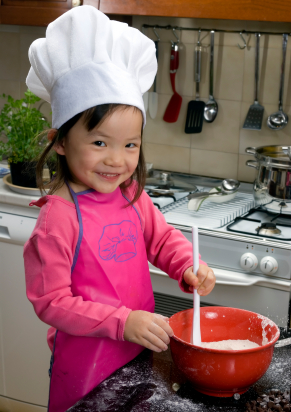
Countless technologies can be used in cooking. Let’s take my experience of making cookies with children as an example:


First step: Preparation. We began with looking up the recipe on the internet on the children’s computer. We looked for the recipe we wanted and printed it recipe out. Then we followed the recipe to prepare our ingredients. The children took turns using different equipments like measuring cups, measuring spoons, scale and such to measure the ingredients. Research shows that computers are more likely to be valuable instructional tools when teachers are personally comfortable using them (Tsanits, Bewick, & Thouvenelle, 2003). Using a computer to search for information on the internet is a common modern digital technology. Involving this technology into our daily routine helps connecting links between the centre and wider world (Ministry of Education, 1996). Measuring ingredients with different equipments helps children develop competence in mathematical concepts and may stimulate their interest of using them in daily life (Ministry of Educaiton, 1996, p.94).

Cookie Cutters
 and Noodle Makers
Second Step: Making the cookies. We put all the ingredients into a big bowl like we do in sand-water play. We used a large spoon to whisk and mix the ingredients into cookie dough. I told the children that making cookies is just like our pretended cooking play with play dough. We used tools from our play dough trolley. We used rollers to roll the dough flat. We used cookie cutters, knives to cut them. We also used noodle maker to squeeze the dough into funny shapes. This is a process that contains a variety of technologies for different purposes. Children explore these tools of technologies, learn about how they work and put them into use (Ministry of Education, 1996). Linking the technology in cooking with those that children are familiar with help them helps them to understand the use of the technologies. It also helps them to understand that technology is transferable in different situations.

Third Step: Cooking the cookies. We put our cookies onto cooking trays. We took the cookies into the kitchen. I turned the oven on and told them that we need to wait 10 minutes until the oven is heated. We came back after 10 minutes and put the cookies in. We timed 12 minutes, took the cookies out, put the tray on cooling rack to cool off. In this process, technologies are used to deal with the heat. Simple as using the oven on to make the things inside hot, putting hot tray on cooling rack to protect the bench from being burnt. This was an excellent teachable moment to help the children learn about the use of these practical resources, so called technology, to expand human possibilities by addressing needs (Ministry of Education, 2007).


Personally, in my teaching, I put more effort on teaching non-digital technology rather than digital technology. Children now grow up around high technology and digital products. It’s true that these do make things easier. Yet, this means that there’s less for us to do. Same as in early childhood, I believe that no teacher will ever show a cooking video to the children, give them some cookies and tell them that’s how they’re made. Children are expected to develop the ability to use media and the technology associated with them (Ministry of Education, 1996). However, no video can produce the same result as the simple movement of squeezing cookie dough out of a noodle maker (Tsantis, Bewick, & Thouvenelle, 2003).

Above all, either digital or non-digital technology can provide quality learning for children. Teacher is the key to effective educational use of technology (Tsantis, Bewick, & Thouvenelle, 2003). Using practical teaching strategies like co-constructing and empowering gives children hands-on experience is one crucial factor. Balancing digital and non-digital technology is another. May I suggest that the previous cooking experience is a fun, handy, and simple way to juggle them!


Google Images. (2012). Image of a child baking. Retrieved from http://cdn.sheknows.com/chefmom/articles/2009/11/little-chef.jpg
Google Images. (2012). Image of two children with a computer. Retrieved from http://computer-monitoring-software.co/images/kids-computer.jpg

Google Images. (2012). Image of cooking-with-kids. Retrieved from http://www.aolcdn.com/photogalleryassets/food/544538/cooking-with-kids-a-365ds032409.jpg
Google Images. (2012). Image of digital technology product Retrieved from http://www.bestdealonline.com.au/images/frontend/tech_other_ban.jpg


Google Images. (2012). Image of technology desk toy. Retrieved from http://www.lbi.co.uk/assets/desktoy.jpg


MacNaughton, G., & Williams, G (2004). Techniques for teaching young children: Choices in theory and practice (2nd Ed). New South Whales, Australia: Pearson Prentice Hall.

Ministry of Education. (2007). The New Zealand curriculum. Wellington, New Zealand: Learning Media.

Ministry of Education. (1996). Te Whāriki: He whāriki mātauranga mo ngā mokopuna o Aotearoa: Early childhood curriculum. Wellington, New Zealand: Learning Media.

Tsantis, L. A., Bewick, C. J., & Thouvenelle, S. (2003). Examining some common myths about computer use in the early years. Young Children, 58(1), 1-9.